Wisdom Teeth Removal Cost UK in 2026
Private dental fees have adjusted slightly due to inflation and the rising costs of clinical materials. On average, removing a single wisdom tooth privately in the UK ranges from £150 to £850
If you are experiencing severe pain, swelling, or crowding in the back of your mouth, it is highly likely that your wisdom teeth are trying to emerge. Understanding the wisdom teeth removal cost in the UK for 2026 is the first crucial step in planning your dental treatment. While this guide focuses entirely on the UK market, it is worth noting that dental tourism is becoming increasingly popular for cost savings. Private dental fees have adjusted slightly due to inflation and the rising costs of clinical materials. On average, removing a single wisdom tooth privately in the UK ranges from £150 to £850, depending on the complexity of the case, the clinic's location, and the specialist's expertise. The vast difference in this price range often causes confusion for patients. Why does one person pay £150 while another pays upwards of £800? The answer lies in the type of extraction required. A straightforward removal of a fully erupted tooth is relatively inexpensive, whereas a deeply impacted tooth wrapped in dense bone requires a highly skilled oral surgeon, advanced imaging, and more clinical time. At dentalPrices, we have analyzed the current market thoroughly to provide you with an accurate, transparent, and comprehensive guide for 2026. This guide breaks down the costs associated with different extraction types, sedation methods, and regional price variations across the UK, helping you make an informed decision for your oral health without facing unexpected financial surprises.
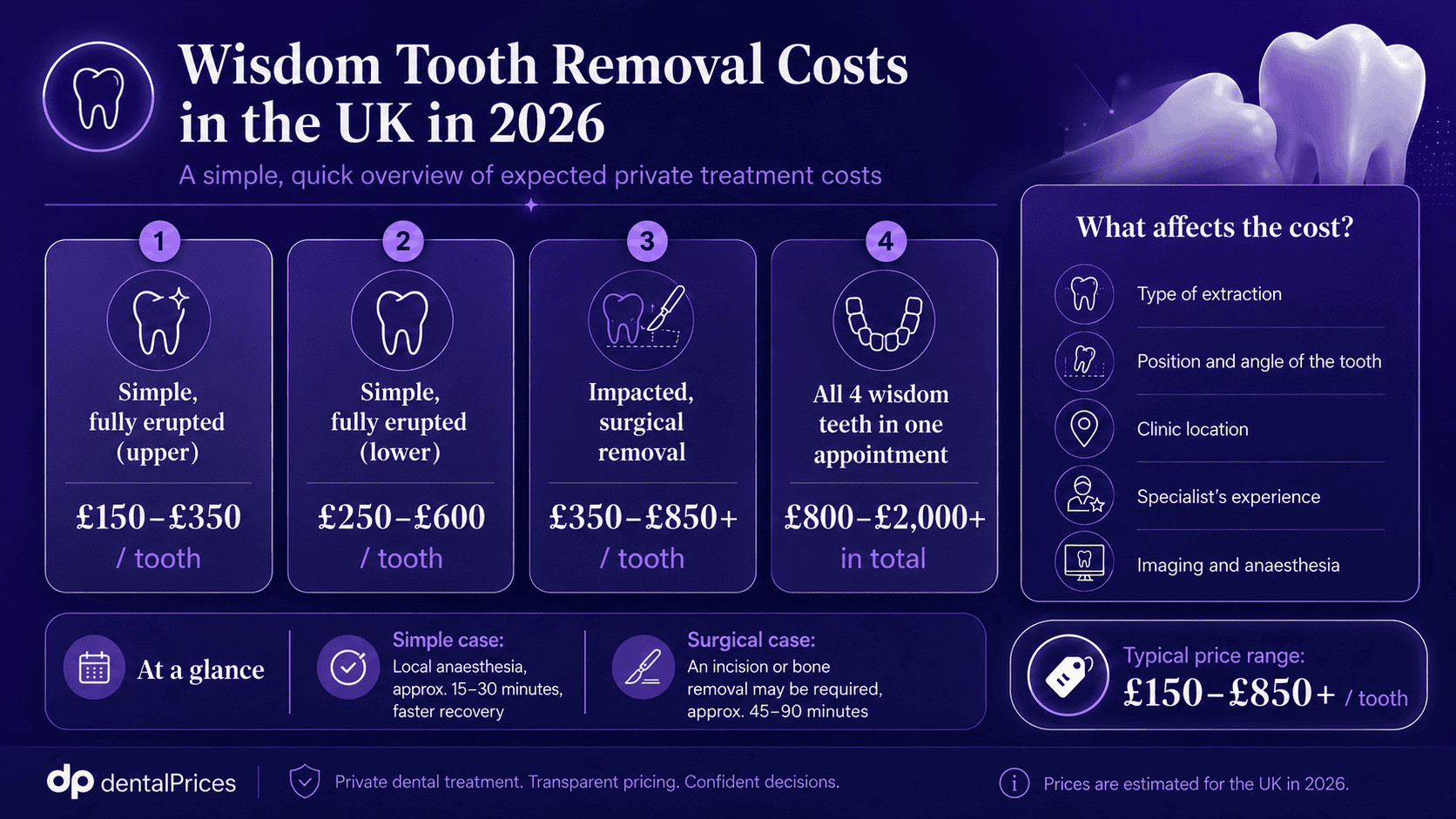
Cost of wisdom tooth extraction by type
When evaluating the financial aspect of oral surgery, it is essential to understand that not all extractions are created equal. The cost of wisdom tooth extraction by type varies significantly because the clinical approach required changes drastically from one scenario to another. Your dentist will take an X-ray or a CBCT scan to determine exactly how the tooth is positioned beneath the gum line. This assessment allows them to categorize the extraction as simple or complex. The physical structure of your jaw, the angle at which the tooth is growing, and whether it has broken through the gum tissue all play a pivotal role in the final invoice. Clinics generally operate on a tiered pricing structure to reflect the time, specialized equipment, and level of expertise necessary to safely remove the tooth without damaging surrounding nerves or adjacent teeth. To make this easier to understand, we have prepared an explanatory price list summarizing the estimated 2026 costs based on the exact type of extraction you might need.
| Extraction Type | Estimated Cost (2026) |
|---|---|
| Simple, fully erupted (Upper) | £150 - £350 per tooth |
| Simple, fully erupted (Lower) | £250 - £600 per tooth |
| Impacted, needing surgery | £350 - £850+ per tooth |
| All four in a single appointment | £800 - £2,000+ total |
Simple, fully erupted
A simple extraction applies to a wisdom tooth that has completely broken through the gum line and is fully visible in your mouth. Because it has erupted just like a normal molar, the dentist can usually grip it with forceps and gently rock it back and forth to loosen the periodontal ligament before pulling it out. For 2026, the cost for a simple, fully erupted wisdom tooth extraction in the UK generally sits between £150 and £350 per tooth. This is the most straightforward and least invasive procedure. It usually requires only a standard local anaesthetic and takes about 15 to 30 minutes in the dentist's chair. You won't typically need a specialist oral surgeon for this; a general dentist is usually perfectly capable of handling it, which keeps the costs at the lower end of the spectrum. Recovery is also generally much faster, meaning you can return to your normal routine with minimal downtime.
Impacted, needing surgery
Impacted wisdom teeth present a much greater clinical challenge and, consequently, a higher price tag. An impacted tooth is one that has been blocked from erupting properly, either by bone, gum tissue, or an adjacent tooth. In 2026, surgical removal of an impacted wisdom tooth will cost you anywhere from £350 to £850 or more per tooth in private UK clinics. This procedure requires a surgical approach, where the dentist or oral surgeon must make an incision in the gum to access the tooth. Often, they will need to remove a small amount of bone covering the tooth, and they may have to section the tooth (cut it into smaller pieces) to remove it safely without causing trauma to the jawbone. Because this requires surgical instruments, stitches, and often the expertise of a specialist oral surgeon, the clinical time is extended to 45–90 minutes. The complexity inherently drives up the operational costs and the final bill you receive.
Upper (usually simpler)
The anatomical location of the wisdom tooth heavily influences both the difficulty of the extraction and the overall cost. Upper wisdom teeth are generally considered much easier to extract than their lower counterparts. The bone in the upper jaw (maxilla) is significantly softer and more porous. As a result, upper wisdom teeth cost less to remove, usually ranging from £150 to £350 per tooth in 2026. Because the bone is less dense, the tooth roots are less tightly anchored, allowing the dentist to remove the tooth more smoothly and quickly. Additionally, there are fewer complex anatomical structures (like major nerves) directly in the pathway of the upper wisdom teeth, reducing the risk of complications. Most upper wisdom tooth extractions are completed efficiently under local anaesthesia without the need for extensive surgical intervention, making it a more budget-friendly and less stressful experience for the patient.
Lower (denser bone, often harder)
Lower wisdom teeth are notorious in the dental field for being problematic, and this reputation is directly reflected in the extraction costs. The lower jawbone (mandible) is incredibly dense and solid compared to the upper jaw. The estimated cost for removing a lower wisdom tooth in 2026 ranges between £250 and £600+, assuming a moderate level of difficulty. The dense bone makes it much harder to loosen and elevate the tooth. Furthermore, lower wisdom teeth are anatomically situated very close to the inferior alveolar nerve, which provides sensation to your lower lip and chin. Dentists must operate with extreme precision to avoid damaging this nerve, which often necessitates the use of advanced 3D imaging (CBCT scans) and specialized surgical techniques. Due to the higher risk, increased clinical time, and the frequent need for an oral surgeon rather than a general dentist, the price for lower extractions is noticeably steeper.
All four in a single appointment
Many patients opt to have all four wisdom teeth removed simultaneously to get the ordeal over with and endure only one recovery period. If you are considering this route in 2026, you can expect the total cost to range from £800 to £2,000+ at a private UK clinic. While this seems like a massive upfront investment, it is actually more cost-effective than having them removed one by one. Dentists often provide a multiple-tooth discount because you are only paying for one clinical setup, one sterilization process, and one consultation block. Having all four removed in a single appointment usually necessitates some form of advanced sedation, which will be an additional cost, but the convenience and consolidated recovery time make it a highly popular choice. It prevents the need for taking multiple days off work throughout the year and resolves all potential wisdom tooth issues in a single, comprehensive procedure.
Cost of sedation options
Dental anxiety is a massive barrier for many patients, especially when the words oral surgery are mentioned. If the thought of having a tooth pulled makes you nervous, you are certainly not alone. For patients who are apprehensive about the operation process and request anaesthesia, we can provide detailed information in this area to ease those fears. The cost of sedation options is an important factor to include in your budget for 2026. Modern dentistry offers fantastic solutions to ensure you feel entirely relaxed and pain-free during the procedure. However, these sedation methods come with their own specific price tags because they require different medications, specialized monitoring equipment, and sometimes the presence of an anaesthetist. Clinics typically offer three main tiers of pain management and sedation: local anaesthetic, intravenous (IV) sedation, and general anaesthetic. Understanding the differences in cost and effect will help you choose the best option for your anxiety levels and your wallet. Let's explore the current 2026 pricing for each of these options.
Local anaesthetic
Local anaesthetic is the baseline standard for any dental extraction and is almost always included in the base price of the tooth removal. There is usually no extra charge for this. It involves the dentist injecting a numbing agent directly into the gum tissue surrounding the wisdom tooth. This ensures that the immediate area is completely numb, meaning you will feel pressure and pushing during the extraction, but absolutely no sharp pain. For patients who are relatively calm and only having a simple, fully erupted tooth removed, a local anaesthetic is perfectly sufficient. The numbness lasts for a few hours after the procedure, providing a comfortable buffer as you travel home. Since it does not alter your consciousness, you remain fully awake and alert, and you are legally allowed to drive yourself home immediately after the appointment, which adds a layer of convenience and cost-saving to your treatment plan.
IV sedation
For patients with moderate to severe dental phobia, or those undergoing complex surgical extractions, IV (intravenous) sedation is highly recommended. In 2026, the cost of IV sedation in the UK typically ranges from £200 to £400 per hour. The sedative is administered directly into your bloodstream through a small cannula in your arm or hand, inducing a state of deep relaxation. You will remain conscious and able to respond to the dentist's instructions, but you will feel entirely detached from the procedure and likely won't remember much of it afterward. Because IV sedation requires specialized training, continuous monitoring of your vital signs, and a longer recovery period in the clinic, it incurs a significant extra charge. You will also be legally required to have a responsible adult escort you home and stay with you for the rest of the day, as your reflexes and judgment will be impaired for several hours.
General anaesthetic
General anaesthetic is the most profound level of sedation, rendering you completely unconscious for the duration of the surgery. In the UK private sector for 2026, general anaesthetic is rarely performed in standard high-street dental practices; it requires a hospital setting or a highly specialized clinical environment. The costs are substantial, usually adding £500 to £1,500+ to your total bill, independent of the extraction costs. This high fee covers the facility costs, the presence of a dedicated consultant anaesthetist, and the comprehensive medical monitoring required when a patient is fully unconscious. General anaesthetic is generally reserved for extremely complex impactions, patients with severe medical or physical disabilities, or intense, unmanageable dental phobia. Due to the high risks and costs involved, most dentists will exhaust all IV sedation options before recommending a general anaesthetic for wisdom teeth removal.
Factors That Affect Wisdom Tooth Extraction Prices
When researching wisdom tooth extraction costs, it becomes immediately apparent that clinics rarely publish a single, flat fee. Instead, you will see prices listed as starting from a certain amount. This is because every patient's mouth is unique, and several critical variables determine the final cost of the procedure. We can explain the factors affecting prices in this area and talk about how our website helps in this regard. At dentalPrices, we assist you by comparing top-rated clinics and breaking down these complex pricing structures so you can easily find a specialist that fits your budget without hidden surprises. The factors that affect wisdom tooth extraction prices are primarily clinical, relating to the difficulty and risk profile of the surgery. However, logistical factors, such as the reputation of the clinic and its geographical location, also play a massive role. Understanding these variables is key to setting a realistic budget. If you walk into a consultation knowing whether your case is simple or complex, you will be much better prepared for the quote you receive. Below, we detail the specific factors that influence the 2026 UK pricing structure for oral surgery.
Tooth Location and Position
The most significant determinant of your extraction cost is the precise location and position of the wisdom tooth within your jaw. As previously mentioned, upper teeth are generally cheaper to remove than lower teeth due to bone density. But the angle of the tooth is equally critical. A tooth that is growing straight up (vertical) is much easier to manage than one that is growing sideways into the adjacent molar (horizontal impaction) or tilting backwards (distoangular impaction). Horizontal and deeply angled impactions require the dentist to carefully cut the tooth into fragments to remove it without shattering the surrounding bone. This meticulous, time-consuming process requires high-level surgical skill. The deeper the tooth is buried in the jawbone, the more expensive the extraction will be, as it demands advanced 3D scanning, greater surgical intervention, and a longer time spent in the operating chair.
Presence of Infection
If your wisdom tooth has partially erupted, it can create a small flap of gum tissue where food particles and bacteria easily become trapped. This frequently leads to a painful infection known as pericoronitis. The presence of infection dramatically complicates the extraction process and can influence the overall cost. Operating on infected, inflamed tissue is difficult; the local anaesthetic often struggles to penetrate the acidic environment of an infection, meaning the dentist may need to use alternative anaesthesia methods or prescribe a course of antibiotics before the surgery can even take place. Treating the infection beforehand requires additional consultation appointments and prescription fees. Furthermore, extracting a tooth from an infected site requires meticulous post-operative cleaning and a more complex aftercare protocol to ensure the infection does not spread into the jawbone, all of which reflect on the final cost of your treatment plan.
Requirement for Surgical Intervention
The line between a simple extraction and a surgical extraction is where the price jumps most significantly. If the dentist can remove the tooth using only forceps and an elevator, the cost remains low. However, if there is a requirement for surgical intervention, the price escalates rapidly. Surgical intervention means the dentist must use a scalpel to slice open the gum tissue to expose the tooth. It often involves using a specialized surgical drill to shave away the jawbone blocking the tooth's exit path. Once the tooth is removed, the area must be thoroughly irrigated, and the gums must be stitched back together with sutures. This process demands sterile surgical kits, specialized equipment, and a higher tier of clinical expertise. In 2026, the moment an extraction is classified as surgical, you can expect the base price to double or even triple compared to a simple removal.
Clinical Setting and Specialism
Who is pulling your tooth, and where are they doing it? The clinical setting and specialism of the practitioner heavily dictate the price. A general dentist working in a standard practice will charge considerably less than a registered Specialist Oral Surgeon. Specialists have undergone years of additional, rigorous training beyond standard dental school to handle the most complex and dangerous extractions, such as teeth wrapped around the mandibular nerve. When you pay a specialist, you are paying for their unparalleled expertise, reduced risk of complications, and ability to handle emergencies. Furthermore, high-end private clinics with luxurious amenities, state-of-the-art 3D CBCT scanners, and premium locations carry higher overhead costs, which are naturally passed down to the patient. Opting for a specialist in a premium clinic will place your quote at the absolute top end of the 2026 price bracket.
Wisdom Tooth Extraction Prices by Region in the UK
Just as property prices vary wildly depending on where you live in the United Kingdom, so do private dental fees. Wisdom tooth extraction prices by region in the UK show a clear North-South divide, heavily influenced by local economic factors, commercial rent costs, and the general cost of living. If you are willing to travel, you might find significant savings by booking your surgery in a different county. However, you must weigh these savings against the cost of transport and the inconvenience of traveling while recovering from oral surgery. For 2026, we have mapped out the average regional costs to give you a clear picture of what you should expect to pay based on your postcode. Keep in mind that these are averages, and highly specialized clinics in any region will always charge a premium rate.
Central London
Central London represents the absolute peak of private dental pricing. Clinics in areas like Harley Street have astronomical overheads. In 2026, simple extractions start at £250, while surgical removals easily exceed £1,000. You are paying for top-tier specialists, luxurious clinical environments, and the ultimate convenience of a prime central location.
Greater London & Home Counties
Moving into Greater London and the Home Counties, prices drop slightly but stay above the national average. Simple extractions typically cost between £180 and £300, while surgical removals sit in the £450 to £750 range. High demand in these affluent commuter belts ensures that private dental fees remain robustly high.
Midlands & South West
The Midlands and the South West offer a much more balanced pricing structure due to a lower cost of living. You can expect to pay around £150 to £250 for straightforward removals. Surgical extractions are generally priced between £350 and £550, providing excellent value and high-quality private surgical care.
North of England
The North of England, including cities like Manchester and Leeds, offers some of the most affordable private dental care. Simple extractions can often be found for £130 to £200. Complex surgical impactions usually range from £300 to £500. Lower clinical overheads make private oral surgery highly accessible across this region.
Scotland & Wales
Scotland and Wales align closely with northern England regarding private fees. In Edinburgh or Cardiff, straightforward extractions hover around the £140 to £220 mark. Surgical removals generally cost between £320 and £500. Both countries boast skilled surgeons, making them cost-effective regions for patients requiring complex procedures without compromising clinical quality.
Frequently Asked Questions about Wisdom Tooth Extraction
Navigating the world of dental surgery can be overwhelming, and patients naturally have many questions before committing to a procedure and its associated costs. We have compiled the most frequently asked questions about wisdom tooth extraction to help clarify any lingering doubts you may have about the 2026 pricing and processes. Whether you are wondering about bulk discounts, the intricacies of impaction, or your eligibility for NHS treatment, understanding these common queries will empower you to have a more productive conversation with your dentist during your initial consultation.
What is the average total cost to remove all four wisdom teeth?
If you are removing all four wisdom teeth privately in the UK in 2026, the average total cost usually falls between £800 and £2,000. The massive variation depends entirely on how many of those four teeth are impacted versus fully erupted. If all four are simple extractions, you will be at the lower end of the spectrum. If all four are horizontally impacted in dense bone, the price will skyrocket. Most clinics offer a bundle rate, so the total will be slightly less than multiplying a single extraction cost by four. Keep in mind that having all four removed usually requires IV sedation, which will add an extra £200 to £400 to your final bill.
Does an impacted tooth increase the extraction price?
Yes, an impacted tooth drastically increases the extraction price. A fully erupted tooth is a simple pull, whereas an impacted tooth is a surgical operation. If the tooth is trapped under the gum or bone, the dentist must cut the gum open, drill away the obstructing jawbone, and often slice the tooth into quarters to safely extract it. This requires surgical equipment, greater clinical expertise, stitches, and significantly more time in the chair. Because of this added complexity and risk, an impacted wisdom tooth will generally cost two to three times more to remove than a simple, fully erupted one.
Are upper wisdom teeth generally cheaper to extract than lower ones?
In almost all cases, yes, upper wisdom teeth are cheaper to extract than lower ones. The anatomy of the upper jaw (maxilla) features bone that is softer and more porous. This allows the dentist to loosen and remove the upper teeth much more easily and quickly. Conversely, the lower jaw (mandible) is made of incredibly dense, thick bone, which locks the roots in tightly. Furthermore, lower extractions carry the risk of damaging the major facial nerve that runs along the jawline. The increased difficulty, time, and surgical risk associated with lower wisdom teeth naturally drive their extraction prices much higher than the upper teeth.
Is wisdom tooth removal available on the NHS?
Yes, wisdom tooth removal is available on the NHS, but there are strict criteria. In England, if your extraction is clinically necessary, it falls under the Band 2 treatment charge, which is £76.60 (as of the 2025/2026 rates). This is a single, flat fee, regardless of whether you need one or all four teeth removed. However, the NHS will not remove wisdom teeth simply to prevent future problems; you must be experiencing severe, recurring infections (pericoronitis), untreatable decay, or cysts. Furthermore, wait times for NHS hospital referrals for complex surgical extractions can be incredibly long, which is why many patients ultimately choose the faster, albeit more expensive, private route.